 Tell us your industry and standard requirements.
Get a recommended equipment solution in 30 seconds.
Dust and sand ingress can seriously damage electronic, mechanical, and electrical products — clogging moving parts, coating circuit boards, and accelerating wear, especially outdoors, in deserts, or industrial settings. LIB dustproof testing solutions help manufacturers verify IP ratings and sand/dust resistance with precision.
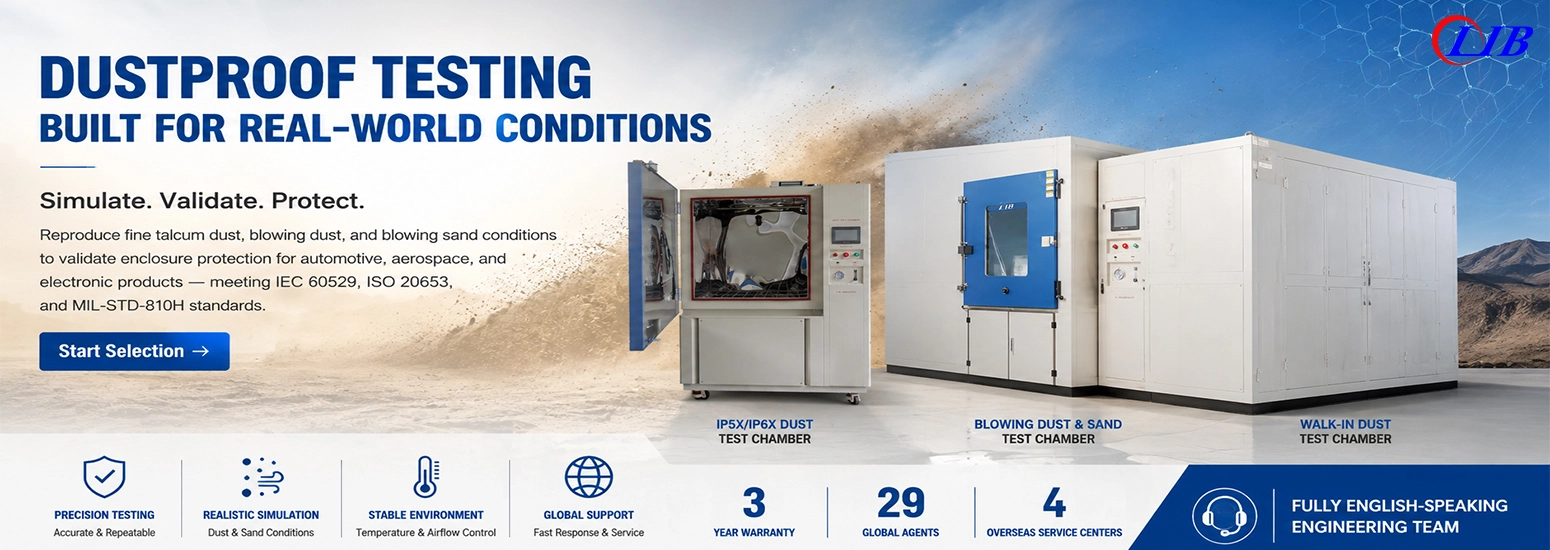
Reproduce fine talcum dust, blowing dust, and blowing sand conditions to validate enclosure protection for automotive, aerospace, and electronic products — meeting IEC 60529, ISO 20653, and MIL-STD-810H standards.
3-Year Warranty 29 Global Agents 4 Overseas Service Centers Fully English-Speaking Engineering Team
Which Test Standard Does Your Industry Need?
Find the right standard and recommended equipment for your industry, or use the selector tool above.
|
Industry / Application |
Common Standards |
Recommended Test |
Recommended Equipment |
|
Electronics & Enclosures |
IEC 60529 (IP5X / IP6X) |
Dust ingress (IP5X/IP6X) |
|
|
Aerospace & Defense |
MIL-STD-810H Method 510 / IEC 60068-2-68 |
Blowing dust / sand |
|
|
Automotive Sensors & Connectors |
ISO 20653 / IEC 60529 |
Combined dust + water |
|
|
Battery Systems / Large Equipment |
Application-dependent |
Custom / large-scale |
Different products require different dust and sand exposure tests depending on their IP rating target, application, and industry standard.LIB provides environmental simulation solutions for the following dustproof tests:
Dust-Protected Test (IP5X)
IP5X testing evaluates whether dust ingress is limited enough that it does not interfere with the satisfactory operation of a product, though complete dust exclusion is not required.
Common standards:
· IEC 60529 (IP5X)
Dust-Tight Test (IP6X)
IP6X testing evaluates whether a product provides complete protection against dust ingress, using talcum powder and a vacuum-assisted low-pressure test chamber.
Common standards:
· IEC 60529 (IP6X)
Recommended Equipment
|
IP5X/IP6X Dust Test Chamber |
What you're afraid of: an IP rating on the spec sheet that fails in the field A product marketed with an IP5X or IP6X rating that hasn't actually been validated risks dust-clogged moving parts and coated circuit boards showing up after the product ships, not before. This chamber controls dust concentration and airflow within a temperature-controlled environment, verifying the rating your spec sheet claims before it's printed. IP5X + IP6X ingress testing · Dust concentration & airflow control · IEC 60529 / ISO 20653 |

Blowing Dust Test
Blowing dust testing exposes products to fine dust particles circulated by air movement, simulating dusty indoor, industrial, or transport environments.
Blowing Sand Test
Blowing sand testing exposes products to larger sand particles at higher velocities, simulating desert, coastal, or exposed outdoor environments where abrasive particle impact is a concern.
Common standards:
· MIL-STD-810H Method 510
· IEC 60068-2-68
Recommended Equipment
|
What you're afraid of: equipment that seizes up once it's actually deployed in the field Aerospace, defense, and vehicle equipment deployed into desert or exposed outdoor conditions faces abrasive particle impact that standard dust testing doesn't reproduce. This chamber runs adjustable airflow velocity to simulate both fine dust and coarse blowing sand, built specifically for MIL-STD-810H Method 510 validation before deployment, not after a field failure. Adjustable airflow velocity · MIL-STD-810H Method 510 · Fine dust + coarse sand simulation |

Large-Scale / Custom Dust Test
Application-dependent
Battery systems, vehicles, and other large or oversized assemblies often exceed the capacity of standard dust chambers, requiring disassembly or a dedicated large-format testing space.
Recommended Equipment
|
|
What you're afraid of: a battery system too large for any chamber you own Full-size vehicles and battery systems don't fit in a standard dust chamber, forcing manufacturers to either test disassembled sub-components or outsource full-assembly validation entirely. This chamber is customized to the actual size of the equipment, letting large-scale products be validated as a complete assembly instead of a set of assumptions stitched together. Large-scale dust testing · Customized chamber size · Special testing requirements supported |
|


Combined Dust and Water Test (IP5X/IP6X + IPX)
Combined dust and water testing evaluates a product's sealing performance against both dust ingress and water exposure within a single enclosure rating, commonly required for outdoor and automotive products.
Common standards:
· IEC 60529
· ISO 20653
Recommended Equipment
|
What you're afraid of: a sensor that passes dust testing but fails once water gets involved Automotive sensors, connectors, and electronic modules rarely face dust alone in the field — they face dust and moisture together, and a rating validated against only one stress leaves the other unverified. This chamber is purpose-built to ISO 20653 requirements with customized fixtures, validating the combined rating vehicle manufacturers actually specify. ISO 20653 compliant · Customized fixtures · Designed for vehicle components |
|


Building a Dustproof Test Laboratory
|
Client South Korean testing agency Year 2019 Scope IP5X–IP6X dust, water & salt spray Support Annual ISO 17025 calibration |
In 2019, a South Korean testing agency approached LIB to help build a complete IP testing laboratory to better serve its clients — covering dust ingress from IP5X to IP6X, along with water ingress and salt spray testing. LIB designed and supplied a full dust and water test system, including dedicated IP5X/IP6X dust chambers alongside IPX water test equipment, with engineers on-site for installation and commissioning. LIB continues to provide annual ISO 17025 calibration support to keep the lab's dust and water test results accurate and traceable year after year. This project reflects LIB's capability to deliver not just individual chambers, but a complete, ready-to-operate dustproof and waterproof test laboratory — from equipment selection to installation and ongoing calibration support. |
|
|
|

Frequently Asked Questions
What equipment is used for dustproof testing?Dustproof testing is usually performed using a dust ingress chamber (IP5X/IP6X), a blowing dust and sand chamber, or a combined dust and water test chamber, depending on the IP rating and standard required.
What is the difference between IP5X and IP6X testing?IP5X testing evaluates whether dust ingress is limited enough that it doesn't interfere with satisfactory operation, though complete exclusion isn't required. IP6X testing evaluates complete protection against dust ingress using talcum powder and a vacuum-assisted low-pressure chamber.
Can dust and water testing be combined?Yes. Combined dust and water testing evaluates sealing performance against both dust ingress and water exposure within a single enclosure rating, commonly required for outdoor and automotive products under IEC 60529 and ISO 20653.
What's the difference between blowing dust and blowing sand testing?Blowing dust testing uses fine particles circulated by air movement to simulate dusty indoor, industrial, or transport environments. Blowing sand testing uses larger, more abrasive particles at higher velocities to simulate desert, coastal, or exposed outdoor conditions.
What warranty and service does LIB industry provide?LIB industry provides a 3-year warranty, lifetime maintenance support, and a fully English-speaking engineering team — backed by 29 agents and 4 overseas service centers worldwide, so support is never far away.
Need a Dustproof Testing Solution?
Whether you need anIP5X test chamber, IP6X test chamber, dust test chamber, dustproof test chamber, Blowing dust and sand test chamber, blowing dust testing, blowing sand testing, or a customized combined dust and water test solution, LIB can provide the right equipment.
Our engineers can recommend the most suitable dust testing equipment based on your product requirements, IEC 60529, ISO 20653, industry standards, and testing objectives.
Need to verify your product's dustproof performance?
Contact LIB today to discuss your dustproof testing requirements.